
Websites for heating and cooling contractors across Metro Vancouver, built around the two things that book jobs: showing up in the right city, and making the call easy at 9pm on a Sunday.
We have built and maintain sites for HVAC companies working in this market, so we are not guessing about how a furnace call comes in.
HVAC Sites We Built in Metro Vancouver
Two heating contractors, two very different problems. Both sites are live and you can check every claim below.
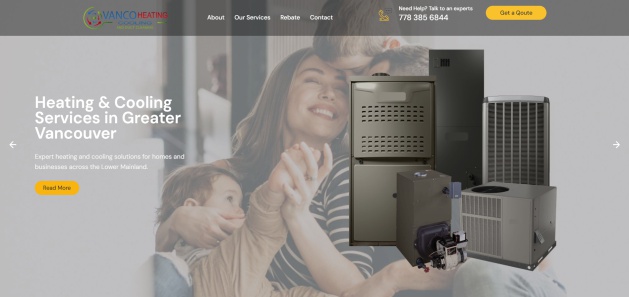
Vanco Heating, Vancouver and the Lower Mainland
Residential and commercial heating and cooling across a wide service area, which meant the site had to answer two questions before anything else: where are you, and how urgent is this.
We built a separate page for Vancouver, North Vancouver, Maple Ridge and the surrounding areas, each one written down to neighbourhood level rather than the same paragraph with a city name swapped, so Lynn Valley, Deep Cove, Edgemont Village, Capilano and Hastings-Sunrise each read like they were written for that street. Individual pages for furnaces, air conditioning, boilers, water heaters, tankless systems and duct cleaning, because someone pricing a boiler replacement and someone with no heat tonight are not the same customer.
And a dedicated 24/7 emergency page, since the emergency call is the most valuable one and should never be buried in a services menu.
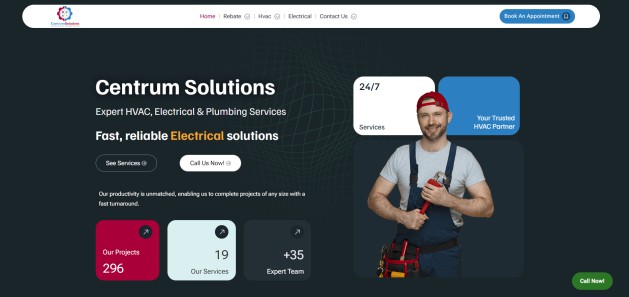
Centrum Solutions, heating, cooling, plumbing and electrical
Centrum is not only an HVAC company. Founder Amir Ali built it around heating, cooling, plumbing, fireplaces and electrical work, serving homeowners, strata management companies, new construction and commercial properties across the Lower Mainland.
A site that tries to be one thing loses most of that. So the structure had to hold four trades without turning into a list nobody reads, and split residential from commercial without duplicating everything. Beyond that, two things drive this business that most HVAC sites ignore entirely.
Rebates come first: heat pump customers in BC can qualify for significant government and utility rebates, and that number is what starts the conversation, so it sits at the top of the site rather than in a footnote. Financing comes second, because a system replacement is a purchase decision rather than a repair, so the FinanceIt options and the current promotions have their own place instead of being buried.
We also pulled their Google reviews directly onto the site. They have built up 66 of them, and for a trade where every customer is choosing between strangers, that is the most persuasive content on the page. It updates itself.
Why a Furnace Call Is Not a Normal Lead
HVAC sits in an unusual spot. Half your work is an emergency, half is a planned purchase.
A homeowner with no heat in January is behaving completely differently from someone budgeting a heat pump replacement in April, and one website has to serve both without looking confused. The numbers back this up.
Around 76 percent of HVAC searches happen on a phone, and bounce rates roughly double once a site takes more than four seconds to load on mobile. About 78 percent of home service leads arrive as a phone call rather than a form. That is why we put a tappable phone number fixed to the bottom of every screen before we think about anything else on the page.
The Page Structure That Books Jobs
Most HVAC sites have one services page listing everything. That page cannot rank for anything specific, and it makes the visitor do the sorting.
- One page per service. Furnace repair, furnace installation, AC repair, AC installation, heat pumps, boilers, water heaters, tankless, duct cleaning. Each one is a different search with different intent and a different price point.
- One page per city you actually serve. Not a list of city names in the footer. A real page for Burnaby, one for Coquitlam, one for Richmond, written with something specific to that area.
- A separate emergency page. Different headline, different urgency, one action. This is the page that earns the after-hours call.
- Financing and maintenance plan pages. A $12,000 system replacement is a financing decision, and a maintenance plan is recurring revenue. Both deserve their own page.
- Real photos. Your technicians, your trucks, your completed installs. Stock photos of smiling models in front of an air conditioner cost you credibility with homeowners who can tell.
What an HVAC Site Costs in Vancouver
Across the market, a custom HVAC contractor site from a local designer or small agency runs roughly $3,500 to $9,000, plus $100 to $400 a month for hosting and maintenance. Larger multi-location builds with dispatch integration go from $15,000 up. Template packages sit at $1,500 to $4,000 and usually mean your site looks like the HVAC company two towns over.
Our pricing is published so you can compare before you book a call.
HVAC Essentials
Up to 12 pages. Your core services each with a page, one service area page, an emergency page, click-to-call on mobile, and a quote form that separates emergency calls from planned work so they do not land in the same inbox.
Analytics and Search Console set up properly.
HVAC Growth
Everything above plus a page for every service you offer and every municipality you cover, online booking or dispatch form integration, financing and maintenance plan pages, and review collection set up during the build rather than promised for later.
Extra service area pages
Added after launch as you expand. Each one is written for that area, not duplicated, because Google ignores duplicated city pages and so do homeowners.
Already have a site that needs rebuilding rather than replacing? Start at website redesign.
Where Your Leads Actually Come From
Worth knowing before you spend anything on a website. For a local HVAC contractor, roughly 60 percent of local visibility comes from your Google Business Profile, 30 percent from your site’s local SEO, and 10 percent from links. Most agencies sell you the 10 percent.
A good website is the 30 percent, and it is necessary. But if your Google Business Profile is half filled in and you have four reviews, a new website will not fix your phone.
We will tell you that before quoting, and if the profile is the real problem we would rather start there. That work lives on our local SEO page.
Handling the Seasonal Spike
HVAC demand is not steady. A cold snap in November or a heat wave in July puts a surge of urgent searches in front of local contractors inside a single week, and whoever loads fastest and answers first takes them.
That is a hosting and speed question as much as a design one. We build for the worst week of the year rather than the average one, and we check your site’s mobile speed against the four second threshold before launch, not after.
That reliability is also why most of our trades clients stay on a care plan after launch. $95 a month covers tested updates, off-server backups and uptime monitoring, so the week your phone should be ringing is not the week your site goes down.
How the Project Runs
Week one, services and areas
We list every service you sell and every municipality you genuinely serve, then check what people in those areas actually search for.
That research sets the page structure. You get a sitemap, a fixed price and a launch date.
Weeks 2 and 3, design
Homepage and one service page first so we agree on the pattern.
Two rounds of revisions included. Mobile designed separately rather than squeezed down.
Weeks 4 and 5, build
Every service and area page built with real content. Forms tested.
Click-to-call tested on actual phones. If you use Jobber, Housecall Pro or a similar system, we connect the booking form to it.
Week 6, launch
Launched outside business hours, redirects mapped from any old addresses, and a walkthrough recording showing how to add a service or update your hours yourself.
4 to 6 weeks is typical. The thing that slows an HVAC project down is almost always photos, so we tell you in week one exactly what to shoot.
Questions HVAC Owners Ask
Who is actually building my site?
Arash Khalaj, who has been building websites for over 17 years and runs Maple Web Design out of Port Coquitlam. You get a direct number, not a ticket system.
How many service area pages do I need?
Only for areas you will genuinely travel to. A page for a city you rarely serve wastes money and brings calls you have to turn down. We would rather build four honest area pages than twelve thin ones.
Can you connect the site to my dispatch software?
Yes. Booking and quote forms can feed into Jobber, Housecall Pro and most similar systems. Tell us what you use in the first call so it is scoped in rather than added later.
Will the site rank for furnace repair in my city?
The site is built to. Structure, speed, page titles and internal linking are all handled during the build. Actually competing in Metro Vancouver takes ongoing work, and our SEO pricing covers what that looks like honestly.
Do you work with plumbers and electricians too?
Yes. The structure is nearly identical for any trade where the customer searches by service and location. Our Vancouver web design page covers the general build.
Can I update it myself?
Yes. Adding a service, changing hours, posting a seasonal offer. Anything structural, ask us first, and that question is free.
Get an HVAC Website Quote
Tell us what services you offer and which areas you cover. You will get a straight answer on scope, price and timeline, and if your Google Business Profile is the better first spend, we will say so.
Serving HVAC contractors in Vancouver, Burnaby, Coquitlam, Port Coquitlam, Port Moody, New Westminster, Richmond and Surrey.